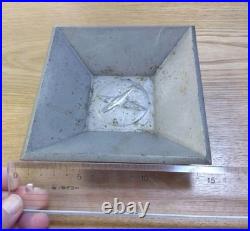

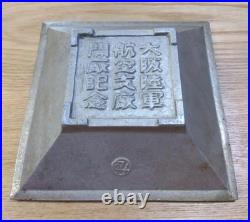

This is an original commemorative metal ashtray produced to mark the opening of the. Osaka Imperial Japanese Army Aviation Arsenal. During the early Showa period. The inscription cast into the base reads. Osaka Army Aviation Arsenal – Opening Commemoration. The Osaka Army Aviation Arsenal was established as a. Logistics and maintenance center. Supporting the Imperial Japanese Army’s growing air power. Unlike front-line air units, aviation arsenals played a crucial behind-the-scenes role. Aircraft maintenance and repair. Storage and supply of aviation equipment. Technical and logistical support necessary for sustained air operations. Osaka was selected due to its strong industrial base, advanced metalworking capabilities, and well-developed transportation networks. The opening of this facility reflects Japan’s shift in the 1930s toward. Long-term, systemized air warfare preparation. Why an Ashtray? In Imperial Japan, it was customary to produce. Such as sake cups, trays, and ashtrays-as official commemorative gifts for military milestones. This ashtray was likely distributed to officers, engineers, or personnel involved in the establishment of the aviation arsenal. It represents a rare example of how military history survives not only through medals or documents, but through everyday objects. Material & Construction. Solid cast metal construction. Heavy and durable, not a lightweight souvenir. Aviation-related motif visible on the base. The industrial character and casting quality strongly reflect military production standards of the period. Shows age-related wear, surface patina, and minor marks consistent with original use. No major damage or structural issues. Collector’s Note. This piece offers insight into the. Logistical foundation of Imperial Japanese Army aviation. An area often overlooked compared to combat units. A compelling artifact for collectors of. Imperial Japanese Army history. Aviation logistics and support units. Pre-war / early WWII military industrial artifacts. Approximate 7-21days(To USA).

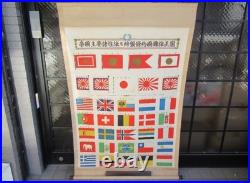

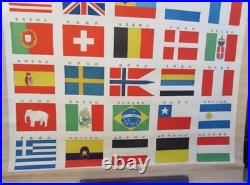
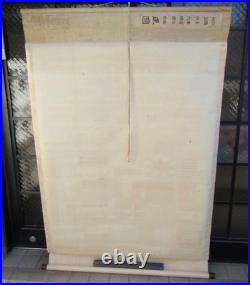


This is a large educational hanging scroll published in 1919 (Taisho 8) by the Great Japan National Flag Company titled. Correct Chart of Imperial Flags and Treaty Nations’ Flags. The publishing details printed on the scroll include. Printed March 28, 1919 / Published April 1, 1919. This chart was produced as official school teaching material, displaying. Imperial flags such as the Emperor’s flag, Crown Prince’s flag, military and naval flags, and the national flag. Flags of major world powers and treaty nations of the time. 1919 marks the period right after World War I, when Japan became a permanent member of the League of Nations. Educational materials emphasizing international awareness and imperial identity were widely used in classrooms during this era. The scroll measures approx. It shows stains and signs of age, but Taisho-period flag charts preserved in scroll format are extremely rare, making this a valuable piece for collectors of vexillology and pre-war educational materials. Own a Piece of History. International Buyers – Please Note. Thank you for your understanding.

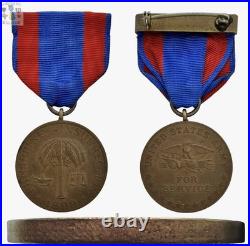
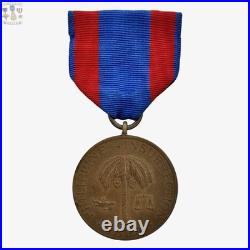
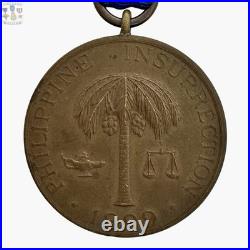
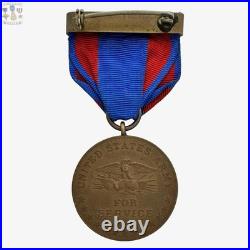
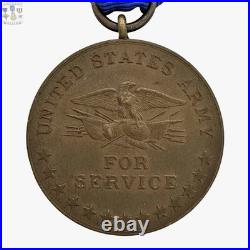

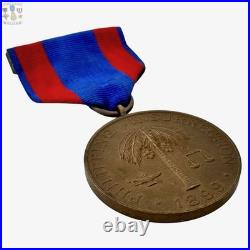
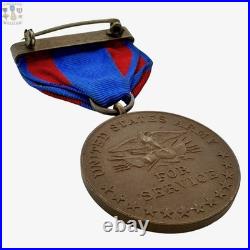
UNITED STATES ARMY PHILIPPINE INSURRECTION CAMPAIGN MEDAL W/ FULL WRAP BROOCH. STUDLEY, PRODUCED BY DAVIDSON OF PHILADELPHIA. The Philippine Campaign Medal is a medal of the United States Armed Forces which was created to denote service of U. Military men in the Philippine-American War between the years of 1899 and 1913. Although a single service medal, the Philippine Campaign Medal was issued under separate criteria for both the United States Army and the U. Please let me know if there’s anything else I can do for you!

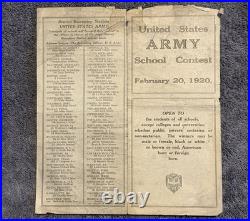
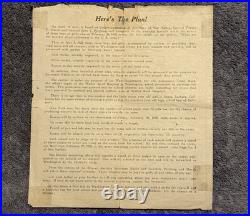
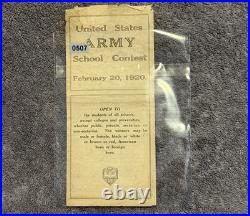
Folded and toned with small edge tears and light paper losses at the folds. All text remains clearly legible, and both panels are intact – no modern reproduction or copy. See photos for exact condition. Rare Original 1920 U. Army “School Contest” Circular Issued February 20, 1920 – U. Offered here is an authentic U. Army pamphlet/broadside titled: United States Army School Contest – February 20, 1920. This rare piece of early post-World War I military recruiting ephemera promoted a nationwide essay competition for American school students – open to boys or girls of any color, any age, American born or foreign born. It represents one of the first inclusive public Army campaigns after World War I, blending education, patriotism, and civic duty. In the wake of World War I, the U. Army faced the task of reshaping its image to the American public. By 1920, Secretary of War Newton D. Baker, General John J. Pershing, and General Peyton C. March organized this nationwide “School Contest” to promote understanding of the Army’s values and to encourage enlistment through positive youth engagement. Students were invited to write essays on. What are the benefits of an enlistment in the U. The plan, printed on the second page, details the prizes. Gold Medal (1st place) – Presented personally by Secretary Baker. Silver & Bronze Medals for runners-up. All-expenses-paid trip to Washington, D. For finalists and their guardians. The contest also involved 50 Army district recruiting stations across the country, each listed in detail on the interior panel (including New York, Chicago, San Francisco, Dallas, and others). Judges were instructed to assess entries based on originality, expression, and sincerity. This pamphlet is not only a military relic – it’s a snapshot of America’s social and racial attitudes in 1920, with the text stating. The winners may be male or female, black or white or brown or red, American born or foreign born. That inclusive statement, remarkable for its time, reflects early steps toward equality within national institutions, decades before civil rights reforms. Why It’s Significant. Issued just after WWI (1920) – bridging wartime propaganda and early 20th-century civic outreach. Mentions major historical figures : Secretary of War Newton Baker & General John J. Inclusion of all races and genders – rare and historically progressive language for the era. Recruiting offices – useful for researchers tracing early Army organization. Scarce surviving example – ephemeral item, rarely saved, especially complete. Pieces like this were meant for school bulletin boards and classrooms – very few survived over a century later. Dated: February 20, 1920. 8.5″ x 11″ (folded). Printed in black on cream/tan stock. Contains complete list of U. Army Recruiting Stations nationwide. Reverse text: Here’s The Plan! With details of prizes and judging. Tags: WWI Recruiting Ephemera, 1920 Army Brochure, U. Army School Contest, Military History Paper, Vintage Army Document, Rare Military Ephemera, U. Army Recruiting 1920, WWI Era Memorabilia, Antique Government Pamphlet, Early 20th Century Ephemera, American Military Collectible, Historical Paper Document, U. War Department, Vintage Army Advertising, Pre-WWII Military History, Military Collectibles, U. Army History, Antique Military Brochure, 1920 U.

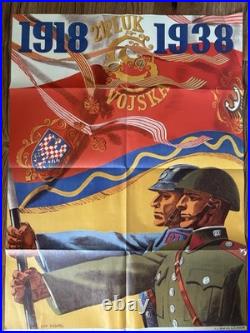
20th anniversary of the Czechoslovak Army and Legionnaires- 1918- 1938 poster. The poster is a newer reprint, it is folded and preserved. 80 x 58 cm. (you can see everything in the photos).

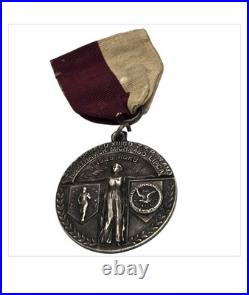
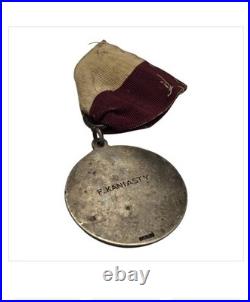
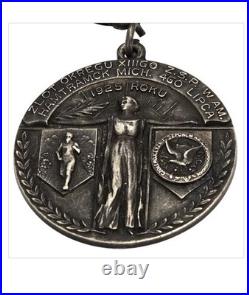
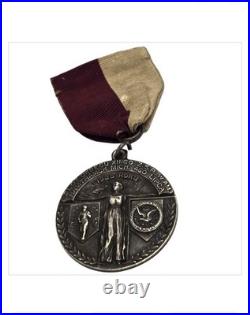
A commemorative medal from the Polish Falcons of America Zwiazek Sokolstwa Polskiego w Ameryce – Z. , specifically commemorating an event held in Hamtramck, Michigan, in 1925. Here’s a breakdown of the medal’s significance. Organization: The Polish Falcons of America is a non-profit fraternal benefit society founded in 1887, emphasizing physical fitness, Polish heritage, and patriotic ideals. Text Inscriptions: The medal bears the inscription ZLOT OKREGU XIIIGO HAMTRAMCK MICH. 4GO LIPCA”, which translates to “13th District Convention Hamtramck Mich. This indicates it was likely issued for a district convention or gathering of the Polish Falcons in Hamtramck on July 4th, 1925. Symbolism: The imagery, including a figure running, a central female figure, and a shield with an eagle and the motto “CZOLEM OJCEYZNIE SZPONEM WROCOWI” (“Forehead to the Homeland, Talon to the Enemy”), reflects the organization’s focus on physical prowess, Polish patriotism, and the pursuit of Polish independence. Historical Context: The Polish Falcons played a significant role in promoting Polish culture and supporting Poland’s independence, particularly during and after World War I, including fostering physical fitness and military training among Polish Americans.

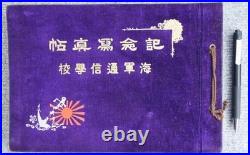
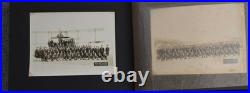
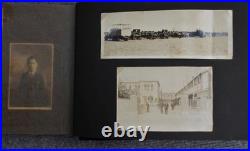
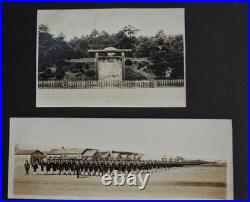
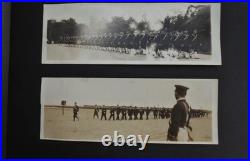
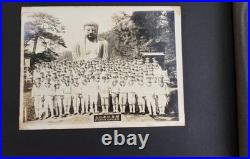
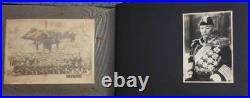
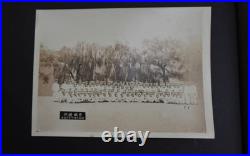
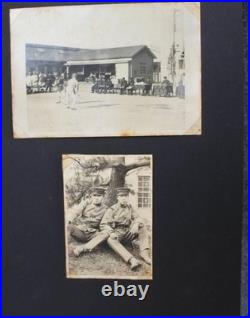
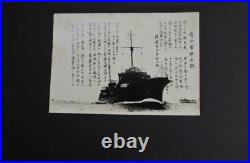
This is an original Imperial Japanese Navy Communications School commemorative photo album, dated 1936 (Showa 11). The year 1936 marks a crucial period in Japanese naval history, following Japan’s withdrawal from international naval disarmament treaties. During this time, the Navy rapidly expanded its fleet operations, aviation forces, and communications systems. Military communications played a vital role in fleet command, aviation coordination, and encrypted transmissions. The Navy Communications School trained specialized officers and personnel for these roles. Compared to general service branches, the number of communications specialists was limited, making surviving photographic records relatively scarce. This album contains approximately 32 original vintage photographs, including. Marching and training scenes. Rather than a casual personal album, this is a formal commemorative album produced within a naval educational institution, offering valuable insight into pre-war Japanese naval training. Condition shows age-related toning and minor stains, but image clarity remains good overall. The cloth cover shows light wear consistent with age. A solid reference piece for collectors of Imperial Japanese Navy material, military education history, and pre-World War II photography. Approximate 7-21days(To USA).

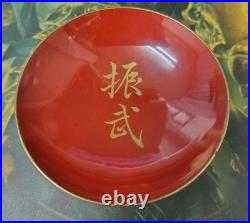
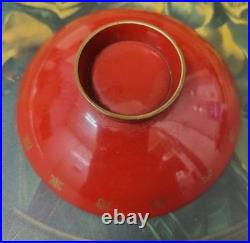
This is an original Imperial Japanese Army commemorative sake cup dating to 1931 (Showa 6). Around the rim, the following inscription is clearly written in Japanese. “Showa 6 – Imperial Japanese Army Special Grand Maneuvers”. What were the 1931 Army Special Grand Maneuvers? The Imperial Japanese Army Special Grand Maneuvers were large-scale, officially organized military exercises held periodically to test command structure, troop coordination, and national defense readiness. The 1931 maneuvers are particularly significant, as they were conducted in the same year as the Manchurian Incident, a turning point in East Asian history. These exercises were not ceremonial events, but serious preparations reflecting rising international tensions and Japan’s expanding military posture at the time. As a result, items related to the 1931 maneuvers are regarded today as important pre-war historical artifacts, rather than simple souvenirs. Meaning of the inscription ” (Shinbu)”. The center of the cup bears the gold-lettered phrase. This term can be translated as to inspire and uphold martial spirit. It was commonly used by the Imperial Japanese Army to express ideals of discipline, morale, and duty. Its presence strongly indicates that this cup was produced for an official military occasion, not for private or commercial sale. The special relationship between the Japanese Army and sake cups. In the Imperial Japanese Army, sake cups were deeply symbolic objects. They were used during. Rather than everyday drinkware, these cups served as ritual objects representing loyalty, unity, and remembrance. Commemorative cups bearing specific dates and events were typically distributed only to participants or officials, which makes surviving examples relatively scarce today. Japanese lacquer craftsmanship. This cup is finished in traditional Japanese lacquer (urushi). Japanese lacquerware is known for. Resistance to moisture and decay. Beautiful aging over time. Each piece was hand-coated in multiple layers, making true lacquer items difficult to mass-produce. Even military-issued lacquerware adhered to a certain quality standard, and many were lost or damaged during the war years. The remaining surface wear and aging visible today are consistent with an authentic pre-war lacquer piece and add to its historical character. Shows expected wear, scratches, and surface aging consistent with age. No major cracks or structural damage. This item is offered as a historical artifact, not as functional drinkware. An authentic 1931 Imperial Japanese Army commemorative lacquer sake cup, directly connected to a pivotal year in modern Japanese history. Highly suitable for collectors of. Imperial Japanese military memorabilia. Approximate 7-21days(To USA).

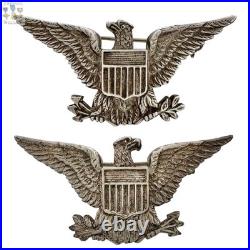
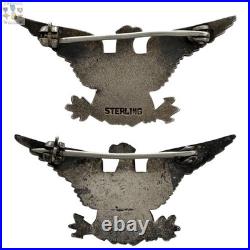

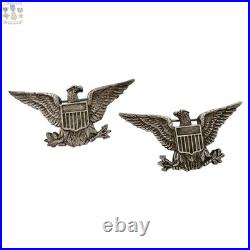
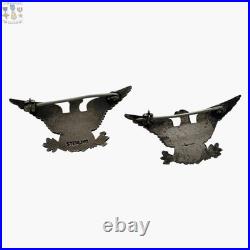
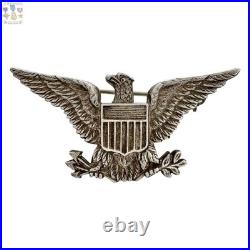

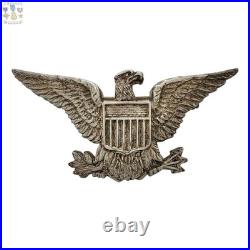
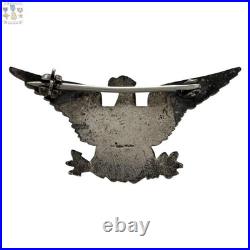
ORIGINAL 1930’S UNITED STATES ARMY & MARINE CORPS COLONEL – NAVY CAPTAIN “WAR EAGLES” INSIGNIA, 1-3/8 INCH X 3/4 INCH SIZE, PIN-BACK W/ LOCKING CATCH. (1 SET OF 2). The insignia for a colonel is a silver eagle which is a stylized representation of the eagle dominating the Great Seal of the United States (which is the coat of arms of the United States). As on the Great Seal, the eagle has a U. Shield superimposed on its chest and is holding an olive branch and bundle of arrows in its talons. However, in simplification of the Great Seal image, the insignia lacks the scroll in the eagle’s mouth and the rosette above its head. On the Great Seal, the olive branch is always clutched in the eagle’s right-side talons, while the bundle of arrows is always clutched in the left-side talons. The head of the eagle faces towards the olive branch, rather than the arrows, advocating peace rather than war. As a result, the head of the eagle always faces towards the viewer’s left. Some colonel eagles from the 1920s to the 1950s faced the arrows, though this is no longer done. The full-sized colonel eagle is exactly two inches in diameter from the tips of each wing. Please let me know if there’s anything else I can do for you!