

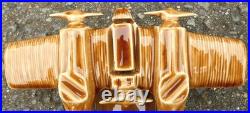
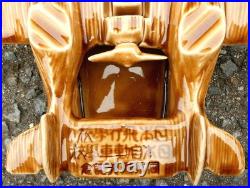
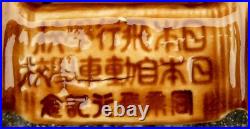

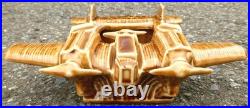
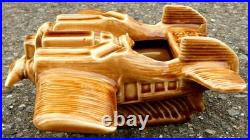
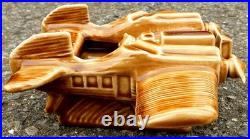

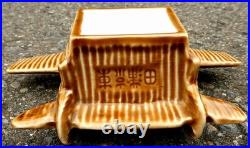

When Flying Was Still an Extraordinary Adventure Today, flying across the world is something many people take for granted. But approximately 100 years ago, boarding an airplane in Japan was an extraordinary experience. This fascinating antique ceramic ashtray commemorates that remarkable era in Japanese aviation history. Beautifully shaped like a twin-engine airplane, it features two propellers, broad wings, intricate details, and a rich brown glaze. More importantly, its Japanese inscriptions reveal a story that goes far beyond its unusual appearance. The Inscriptions Tell the Story The following Japanese inscriptions appear on the piece: – Japan Flying School An early Japanese aviation school involved in training pilots during the pioneering years of flight. Japan Automobile School An automobile training institution historically connected with the Japan Flying School. Commemorating a Passenger Flight This inscription indicates that the piece was created to commemorate the experience of flying aboard an airplane. Kamata, Tokyo A district of Tokyo associated with the schools’ early aviation activities. Together, these inscriptions connect the ashtray to a specific place, two educational institutions, and the unforgettable experience of early flight. Dating the Piece: Japan’s Aviation Pioneering Years The Japan Flying School was originally established in 1917. In 1921, aviation training became associated with the Japan Automobile School in Kamata, Tokyo. A training facility was subsequently established at Tachikawa Airfield in 1923. Because this ashtray bears the names of both schools and the location “Tokyo Kamata, ” it may date from the 1920s, particularly the late Taisho to early Showa period. The exact manufacturing date remains unknown. Imagine Seeing Japan from the Sky for the First Time Imagine stepping aboard an airplane at a time when flying was still a rare adventure. The propellers begin to turn. Then, suddenly, the ground falls away. The streets, houses, rivers, and fields of Japan appear below in a way few people had ever experienced. For someone taking a commemorative passenger flight, it may have been an unforgettable day. This little ceramic airplane preserves a connection to that remarkable experience. From Civil Aviation to Aviation History Early civilian flying schools played an important role in developing Japan’s aviation knowledge and training future pilots. During the following decades, aviation became increasingly important to both civilian transportation and military development. Although this ashtray is not identified as military-issued equipment, it represents an interesting chapter in the history of Japanese aviation before World War II. Details & Condition Antique Japanese ceramic airplane-shaped ashtray Twin-engine aircraft design with two propellers Brown glazed finish Inscriptions identifying Japan Flying School and Japan Automobile School Commemorative passenger flight inscription “Kamata, Tokyo” location marking Likely associated with the early decades of Japanese aviation Exact manufacturing date and aircraft model are unknown Please carefully examine the photographs for the condition and details. A Small Piece of Aviation History This is more than a decorative ceramic airplane. It preserves the names of two schools, a place in Tokyo, and the memory of a time when taking to the skies was something truly extraordinary. Nearly a century later, that sense of wonder remains. Own a Piece of History. International Buyers – Please Note.

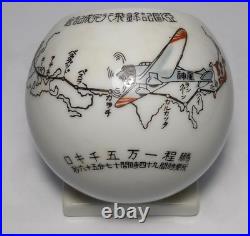
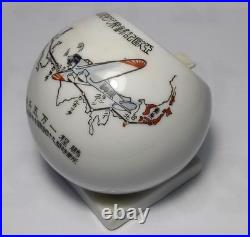

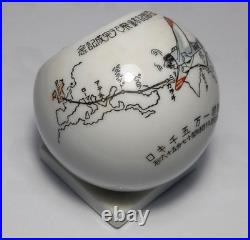

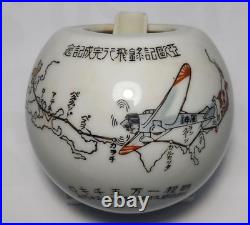

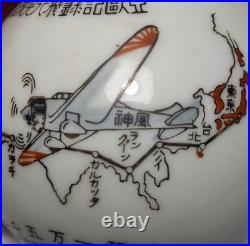
This spherical ceramic ashtray commemorates the historic 1937 Tokyo-to-London record flight of the Japanese aircraft. Operated by the Asahi Shimbun newspaper company. Although the word “Kamikaze” later became internationally associated with Japanese suicide attacks during World War II, this aircraft had no connection to those missions. Was simply the name given to a celebrated prewar record aircraft. Across the upper section is the inscription. “Commemorating the Completion of the Asia-Europe Record Flight”. The aircraft is marked. “Kamikaze” or “Divine Wind”. A map traces the aircraft’s journey from Japan across Asia and Europe. Place names shown on the route include. The lower inscription reads. “A Great Journey of 15,000 Kilometers”. Is a classical expression referring to an extraordinarily long and ambitious journey, literally evoking the legendary giant bird. Flying across an immense distance. Below this is written. “Total Elapsed Time: 94 Hours, 17 Minutes and 56 Seconds”. These inscriptions transform the ashtray into a miniature visual record of the entire achievement. A Flight That Astonished the World. Flying from Tokyo to London may seem routine today, but in 1937 it represented the outer limit of aviation technology. There were no jet airliners, satellite navigation systems or modern weather forecasting networks. A journey of approximately 15,000 kilometers required careful fuel calculations, reliable mechanical performance, navigation across unfamiliar territory and repeated landings at airfields scattered across Asia, the Middle East and Europe. Kamikaze-Go departed Tokyo on April 6, 1937, and completed the journey in a total elapsed time of 94 hours, 17 minutes and 56 seconds. Its actual time in the air was slightly over 51 hours. The achievement established an internationally recognized record and made it the first Japanese-built aircraft to fly from Japan to Europe. At the time, the flight was a national sensation. It demonstrated that a Japanese-designed and manufactured aircraft could cross continents at a speed and level of reliability competitive with the world’s leading aviation nations. Connection to Japanese Military Aviation. Kamikaze-Go was based on the Mitsubishi. An advanced high-speed aircraft design that was subsequently adopted by the Imperial Japanese Army as the. Type 97 Command Reconnaissance Aircraft. It would not be accurate to describe this aircraft as a Zero fighter or as a direct predecessor of the Zero. However, it belonged to the same rapidly developing Japanese aviation industry that later produced famous military aircraft such as the Mitsubishi A6M Zero. The Ki-15 demonstrated several qualities that became characteristic of Japanese aircraft development during the late 1930s: speed, long range, relatively light construction and efficient use of engine power. This ashtray therefore stands at an interesting intersection between. Civilian record aviation, national prestige and the rapid development of Japan’s prewar military aviation industry. This was not merely a souvenir celebrating a long-distance journey. To people living in 1937, it represented a glimpse of the future. At a time when international air travel remained beyond the reach of most ordinary people, a Japanese aircraft had crossed almost the entire Eurasian continent in less than four days. The spherical form, illustrated route map, rising-sun markings and detailed flight statistics preserve the excitement that surrounded the achievement. Today, it is an unusual display piece for collectors of. Imperial Japanese military aviation. Early long-distance record flights. Japanese ceramic advertising and commemorative objects. There is age-related discoloration, surface wear and loss to portions of the painted aircraft design, particularly around the nose and engine area. Please review the photographs carefully for the condition and details. More than an ashtray, this is a surviving souvenir from the moment Japan announced its arrival on the world aviation stage. Own a Piece of History. International Buyers – Please Note. Thank you for your understanding.

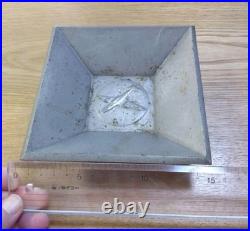

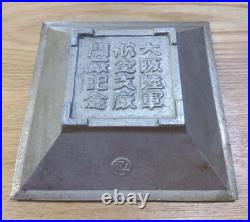
This is an original commemorative metal ashtray produced to mark the opening of the. Osaka Imperial Japanese Army Aviation Arsenal. During the early Showa period. The inscription cast into the base reads. Osaka Army Aviation Arsenal – Opening Commemoration. The Osaka Army Aviation Arsenal was established as a. Logistics and maintenance center. Supporting the Imperial Japanese Army’s growing air power. Unlike front-line air units, aviation arsenals played a crucial behind-the-scenes role. Aircraft maintenance and repair. Storage and supply of aviation equipment. Technical and logistical support necessary for sustained air operations. Osaka was selected due to its strong industrial base, advanced metalworking capabilities, and well-developed transportation networks. The opening of this facility reflects Japan’s shift in the 1930s toward. Long-term, systemized air warfare preparation. Why an Ashtray? In Imperial Japan, it was customary to produce. Such as sake cups, trays, and ashtrays-as official commemorative gifts for military milestones. This ashtray was likely distributed to officers, engineers, or personnel involved in the establishment of the aviation arsenal. It represents a rare example of how military history survives not only through medals or documents, but through everyday objects. Material & Construction. Solid cast metal construction. Heavy and durable, not a lightweight souvenir. Aviation-related motif visible on the base. The industrial character and casting quality strongly reflect military production standards of the period. Shows age-related wear, surface patina, and minor marks consistent with original use. No major damage or structural issues. Collector’s Note. This piece offers insight into the. Logistical foundation of Imperial Japanese Army aviation. An area often overlooked compared to combat units. A compelling artifact for collectors of. Imperial Japanese Army history. Aviation logistics and support units. Pre-war / early WWII military industrial artifacts. Approximate 7-21days(To USA).


1932 German ashtray Helmet Soldiers hat Stahlhelm Germany Military RAD bronze 83x63x9mm 194g 896. Good item for your collection or gift for holidays! If you have any question – please write me. You can make your best offer for this item.


Ashtray made from the Copper removed from the US Frigate Constitution “Old Ironsides”. Condition : There may be minor scuffs, scratches, minor paint loss from normal wear. Please ignore the shiny white marks created by my camera’s flash. 4 1/2″ diameter x 3/8″ deep. Thank you for viewing my listing. Payments should be received within 3 days, if you need more time please let me know. If you require anything extra or want to insure lower priced items please contact me. Thank you for your interest. Please contact me if that is your wish.


Up for sale is an amazing rare early vintage 1927, Bronze ashtray made from material taken from THE U. Condition is good, maintains original patina, shoes light surface wear and oxidation, please see detailed pictures for a closer look at condition. Measures 6-1/2 x 5 x 1. AMAZING RARE early vintage piece, special and unique with stunning embossed graphics, would make the prefect addition to your naval military memorabilia collection and display. Please see pictures for condition and details. Armada Antiques & Collectibles. Please see photos for details, let us know if you need additional photos for details. The item “Vintage 1927 USS Constitution Bronze Ashtray Made From Material Taken From Ship” is in sale since Friday, January 10, 2020. This item is in the category “Collectibles\Militaria\1919-38\Original Period Items”. The seller is “armada_antiques” and is located in Ogunquit, Maine. This item can be shipped worldwide.