
1937 Japanese Kamikaze-Go Tokyo London Record Flight Ceramic Ashtray
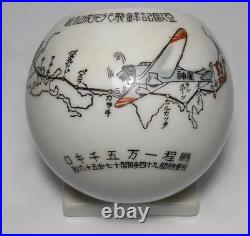


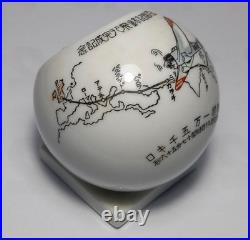



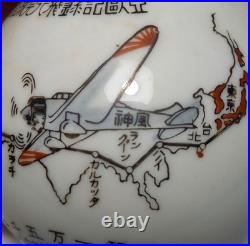

This spherical ceramic ashtray commemorates the historic 1937 Tokyo-to-London record flight of the Japanese aircraft. Operated by the Asahi Shimbun newspaper company. Although the word “Kamikaze” later became internationally associated with Japanese suicide attacks during World War II, this aircraft had no connection to those missions. Was simply the name given to a celebrated prewar record aircraft. Across the upper section is the inscription. “Commemorating the Completion of the Asia-Europe Record Flight”. The aircraft is marked. “Kamikaze” or “Divine Wind”. A map traces the aircraft’s journey from Japan across Asia and Europe. Place names shown on the route include. The lower inscription reads. “A Great Journey of 15,000 Kilometers”. Is a classical expression referring to an extraordinarily long and ambitious journey, literally evoking the legendary giant bird. Flying across an immense distance. Below this is written. “Total Elapsed Time: 94 Hours, 17 Minutes and 56 Seconds”. These inscriptions transform the ashtray into a miniature visual record of the entire achievement. A Flight That Astonished the World. Flying from Tokyo to London may seem routine today, but in 1937 it represented the outer limit of aviation technology. There were no jet airliners, satellite navigation systems or modern weather forecasting networks. A journey of approximately 15,000 kilometers required careful fuel calculations, reliable mechanical performance, navigation across unfamiliar territory and repeated landings at airfields scattered across Asia, the Middle East and Europe. Kamikaze-Go departed Tokyo on April 6, 1937, and completed the journey in a total elapsed time of 94 hours, 17 minutes and 56 seconds. Its actual time in the air was slightly over 51 hours. The achievement established an internationally recognized record and made it the first Japanese-built aircraft to fly from Japan to Europe. At the time, the flight was a national sensation. It demonstrated that a Japanese-designed and manufactured aircraft could cross continents at a speed and level of reliability competitive with the world’s leading aviation nations. Connection to Japanese Military Aviation. Kamikaze-Go was based on the Mitsubishi. An advanced high-speed aircraft design that was subsequently adopted by the Imperial Japanese Army as the. Type 97 Command Reconnaissance Aircraft. It would not be accurate to describe this aircraft as a Zero fighter or as a direct predecessor of the Zero. However, it belonged to the same rapidly developing Japanese aviation industry that later produced famous military aircraft such as the Mitsubishi A6M Zero. The Ki-15 demonstrated several qualities that became characteristic of Japanese aircraft development during the late 1930s: speed, long range, relatively light construction and efficient use of engine power. This ashtray therefore stands at an interesting intersection between. Civilian record aviation, national prestige and the rapid development of Japan’s prewar military aviation industry. This was not merely a souvenir celebrating a long-distance journey. To people living in 1937, it represented a glimpse of the future. At a time when international air travel remained beyond the reach of most ordinary people, a Japanese aircraft had crossed almost the entire Eurasian continent in less than four days. The spherical form, illustrated route map, rising-sun markings and detailed flight statistics preserve the excitement that surrounded the achievement. Today, it is an unusual display piece for collectors of. Imperial Japanese military aviation. Early long-distance record flights. Japanese ceramic advertising and commemorative objects. There is age-related discoloration, surface wear and loss to portions of the painted aircraft design, particularly around the nose and engine area. Please review the photographs carefully for the condition and details. More than an ashtray, this is a surviving souvenir from the moment Japan announced its arrival on the world aviation stage. Own a Piece of History. International Buyers – Please Note. Thank you for your understanding.