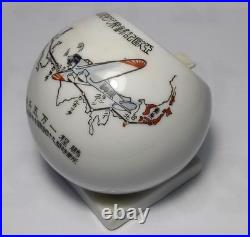
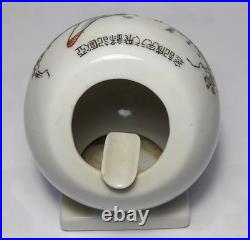
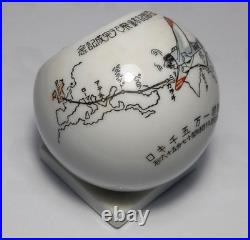
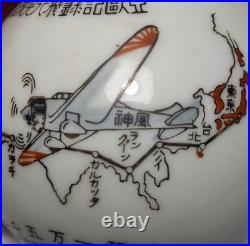
This spherical ceramic ashtray commemorates the historic 1937 Tokyo-to-London record flight of the Japanese aircraft. Operated by the Asahi Shimbun newspaper company. Although the word “Kamikaze” later became internationally associated with Japanese suicide attacks during World War II, this aircraft had no connection to those missions. Was simply the name given to a celebrated prewar record aircraft. Across the upper section is the inscription. “Commemorating the Completion of the Asia-Europe Record Flight”. The aircraft is marked. “Kamikaze” or “Divine Wind”. A map traces the aircraft’s journey from Japan across Asia and Europe. Place names shown on the route include. The lower inscription reads. “A Great Journey of 15,000 Kilometers”. Is a classical expression referring to an extraordinarily long and ambitious journey, literally evoking the legendary giant bird. Flying across an immense distance. Below this is written. “Total Elapsed Time: 94 Hours, 17 Minutes and 56 Seconds”. These inscriptions transform the ashtray into a miniature visual record of the entire achievement. A Flight That Astonished the World. Flying from Tokyo to London may seem routine today, but in 1937 it represented the outer limit of aviation technology. There were no jet airliners, satellite navigation systems or modern weather forecasting networks. A journey of approximately 15,000 kilometers required careful fuel calculations, reliable mechanical performance, navigation across unfamiliar territory and repeated landings at airfields scattered across Asia, the Middle East and Europe. Kamikaze-Go departed Tokyo on April 6, 1937, and completed the journey in a total elapsed time of 94 hours, 17 minutes and 56 seconds. Its actual time in the air was slightly over 51 hours. The achievement established an internationally recognized record and made it the first Japanese-built aircraft to fly from Japan to Europe. At the time, the flight was a national sensation. It demonstrated that a Japanese-designed and manufactured aircraft could cross continents at a speed and level of reliability competitive with the world’s leading aviation nations. Connection to Japanese Military Aviation. Kamikaze-Go was based on the Mitsubishi. An advanced high-speed aircraft design that was subsequently adopted by the Imperial Japanese Army as the. Type 97 Command Reconnaissance Aircraft. It would not be accurate to describe this aircraft as a Zero fighter or as a direct predecessor of the Zero. However, it belonged to the same rapidly developing Japanese aviation industry that later produced famous military aircraft such as the Mitsubishi A6M Zero. The Ki-15 demonstrated several qualities that became characteristic of Japanese aircraft development during the late 1930s: speed, long range, relatively light construction and efficient use of engine power. This ashtray therefore stands at an interesting intersection between. Civilian record aviation, national prestige and the rapid development of Japan’s prewar military aviation industry. This was not merely a souvenir celebrating a long-distance journey. To people living in 1937, it represented a glimpse of the future. At a time when international air travel remained beyond the reach of most ordinary people, a Japanese aircraft had crossed almost the entire Eurasian continent in less than four days. The spherical form, illustrated route map, rising-sun markings and detailed flight statistics preserve the excitement that surrounded the achievement. Today, it is an unusual display piece for collectors of. Imperial Japanese military aviation. Early long-distance record flights. Japanese ceramic advertising and commemorative objects. There is age-related discoloration, surface wear and loss to portions of the painted aircraft design, particularly around the nose and engine area. Please review the photographs carefully for the condition and details. More than an ashtray, this is a surviving souvenir from the moment Japan announced its arrival on the world aviation stage. Own a Piece of History. International Buyers – Please Note. Thank you for your understanding.
1926 GUARDS DIVISION MEMORIAL PROGRAMME HORSE GUARDS PARADE LONDON CONNAUGHT WWI. Unveiling of the Guards Division Memorial. The Duke of Connaught, K. (Senior Colonel of the Brigade of Guards). Gale & Polden Ltd, Aldershot. Official programme for the unveiling of the Guards Division Memorial at Horse Guards Parade, London, presided over by Field-Marshal H. The Duke of Connaught on Saturday, 16 October 1926. Printed by the noted military firm Gale & Polden of Aldershot, this inter-war souvenir documents the ceremony in full: guard of honour and inspection, the address by His Royal Highness, the unveiling formula, the dedication by the Senior Chaplain, prayers, the Brigade Call, Last Post and Réveillé, wreath-laying protocol, and the playing of “The Flowers of the Forest” by the massed pipers. The programme further records an inscription to the fallen of the Foot Guards in the Great War and provides a detailed “Order of Battle” of the Guards Division in France and Flanders, listing divisional headquarters, the 1st, 2nd, 3rd, and 4th Guards Brigades, supporting units (Royal Artillery, Royal Engineers, Royal Army Service Corps, Royal Army Medical Corps, Machine-Gun Regiment, Life Guards squadron, cyclist company, signals, veterinary and ordnance detachments), and the 1918 reorganization. A final spread enumerates the Division’s battle honours as engraved on the memorial-Mons, Ypres, Loos, Somme, Ginchy, Arras, Passchendaele, Cambrai, Bourlon Wood, the Lys, the Hindenburg Line, and many more-offering a concise operational history of the Division’s Great War service. The Guards Division Memorial (often called the Guards Memorial) is the Portland-stone cenotaph with five bronze figures representing each Foot Guards regiment, designed by architect H. Chalton Bradshaw with sculpture by Gilbert Ledward and unveiled on this date by the Duke of Connaught; the day’s proceedings were attended by Crimean War veteran General Sir George Higginson. The programme captures that moment and the inter-war culture of remembrance that followed the First World War in Britain. Side-stapled printed wrappers in cream, gilt title to front with coloured Guards badge; rear wrapper with Gale & Polden imprint. No text loss observed, pages complete, though detaching. Included with the programme is the original printed attendee ticket for the Guards Division Memorial unveiling ceremony, dated. Presided over by Field-Marshal H. The Duke of Connaught and Strathearn, K. The card identifies the bearer as a veteran of the Guards Division and instructs him to report for the Parade by 10.15 a. Dress guidance specifies Full Dress or Service Dress or plain clothes. With medals and decorations. The reverse lists assembly points for each regiment and unit: Grenadier Guards (Chelsea Barracks), Coldstream Guards (Wellington Barracks), Scots Guards (Chelsea Barracks), Irish Guards (Wellington Barracks), Welsh Guards (Hyde Park Barracks), Machine Gun Regiment (Hyde Park Barracks), and Divisional Troops (Wellington Barracks). Make sure to see the photos above for complete details. Measures approximately 8 1/4 inches tall by 5 1/2 inches wide. Guards Division Memorial programme, Horse Guards Parade, London memorial ceremony, 1926 unveiling, Duke of Connaught, Prince Arthur, Brigade of Guards, Foot Guards regiments, Grenadier Guards, Coldstream Guards, Scots Guards, Irish Guards, Welsh Guards, General Sir George Higginson, H. Fleming, Field-Marshal Lord Methuen, guard of honour, wreath laying, Last Post, Reveille, Gale & Polden Aldershot, military ephemera, souvenir booklet, British militaria, Guards regiments history, Westminster Whitehall St James’s Park, Horse Guards Parade ground, Trooping the Colour venue, WWI veterans, Royal Engineers, Royal Artillery, Royal Army Service Corps, Royal Army Medical Corps, Guards Machine Gun Regiment, Life Guards squadron, cyclist company, signal company, vintage programme, 1920s London print history, rare regimental printing, original period item. _gsrx_vers_1730 GS 9.9.4 (1730).
The Submarine Flotilla Journal April 1921 USN New London Connecticut, Early. The Submarine Flotilla Journal April 1921 USN New London Connecticut, Early Navy Submariner Publication, Average Condition. As Photographed with age and some discoloration / water staining as seen (see photos for condition). A Great Candidate for any Collection, War Room, or Library. Recent Estate Collection Acquisition & Presented as Acquired, Rare. Check back often – we search estates and sources across the world to bring a fine selection of militaria. Please review all photos for details regarding the condition of the item listed – further condition information will be included in the listing as is relevant, if you need additional photographs or have questions regarding the condition please do not hesitate to ask. I describe all items to the best of my ability – please do not hesitate to ask any and all questions prior to the close of the listing. Mistakes very rarely occur – however if one does please rest assured that it will be corrected. International Buyers are Welcome!
ORIGINAL, GOOD USED CONDITION. GUARANTEED ORIGINAL USMC MARINE EAGLE GLOBE AND ANCHOR VISOR HAT EAGLE INSIGNIA FROM THE WWI TIME PERIOD OR POSSIBLY INTO THE 1920S. LARGER SIZED EGA USED FOR THE VISOR HAT. GAUNT LONDON ON THE BACK. SCREW BACK IN WORKING ORDER. THE POST ON THE BACK IS BENT. HAS SURFACE WEAR WITH VERDIGRIS. 1 3/4″ X 1 3/4″. THE ITEM WILL CAREFULLY PACKAGED. NOT FOR SALE TO COUNTRIES WHERE THIS ITEM IS PROHIBITED FOR IMPORT. The item “Original WWI US Marine Corps EGA Eagle Globe & Anchor J. R. Gaunt London Cap Eagle” is in sale since Sunday, September 18, 2016. This item is in the category “Collectibles\Militaria\WW I (1914-18)\Original Period Items\United States\Medals, Pins & Ribbons”. The seller is “jaggerbriscoe” and is located in Robesonia, Pennsylvania. This item can be shipped to United States.