



This is an official, non-public photo album published in 1929 (Showa 4) to commemorate the Enthronement Ceremony of Emperor Showa. In pre-war Imperial Japan. Was not only the head of state but the Supreme Commander of the Imperial Japanese Army and Navy. The enthronement ceremony therefore marked the formal transfer of supreme military command, making this event a crucial moment in Japan’s military and political history. Nature of the Album. Its purpose was not decorative, but documentary and institutional-to preserve the official record of a national and military ceremony tied directly to imperial authority and command structure. Cover Inscription (Original Text). The gold-stamped cover reads. (Imperial Enthronement Commemorative Photo Album). The album features a cloth-bound cover with gold lettering, typical of formal military and imperial publications of the era. Contents (Military & Historical Value). The album contains a wide range of official photographs and documents, including. Formal portraits of Emperor Showa and Empress Kojun. Enthronement ceremony processions and rituals. Military formations, guards, and ceremonial troops. Security arrangements and controlled urban spaces. Crowds under strict supervision. Detailed map of the Kyoto Imperial Palace complex. Official explanatory texts and event records. The presence of military uniforms, formations, command hierarchy, and ceremonial discipline clearly reflects the emperor’s role as supreme military authority. This is not a simple commemorative book-it is a visual record of state power and military legitimacy in early Showa Japan. The colophon clearly states. Printed: April 15, 1929. Issued: April 17, 1929. Marked: Non-Public / Not for Sale. These details confirm the album as a primary historical source, not a later reproduction. Expected age-related wear is present, including light toning and minor paper waviness. There are no major tears or missing pages, and the album remains fully usable for study and display. For a pre-war military and imperial document, the condition is comparatively well preserved. Summary (For Collectors & Researchers). Emperor Showa as Supreme Commander of Japan’s armed forces. The enthronement as a formal transfer of military authority. A non-public, institutional publication. A rare visual record of imperial ceremony, military order, and state control. Highly recommended for collectors of Imperial Japanese military history. As well as researchers focusing on command structure, state ritual, and pre-WWII Japan. International Buyers – Please Note. Thank you for your understanding.

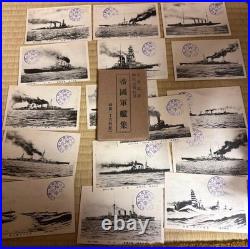
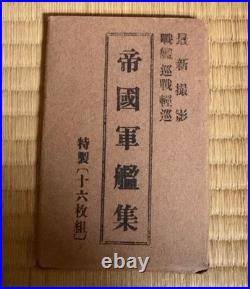
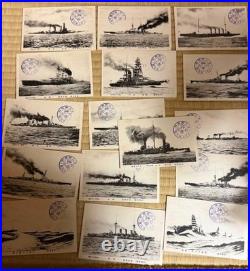
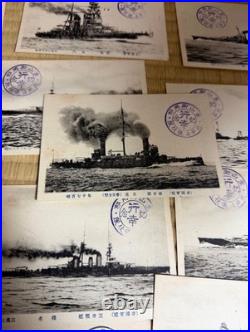
This is an original set of 16 Imperial Japanese Navy warship postcards. Produced in Showa 3 (1928), during the early Showa period. The early Showa era represents a transitional phase in Japanese naval history. Following World War I and the Washington Naval Treaty (1922). During this period, Japan faced strict limitations on battleship construction. Which led the Imperial Japanese Navy to focus on design efficiency, speed, and visual presence rather than sheer numbers. The photographs in this set primarily depict warships underway at sea. Emphasizing their silhouettes, smoke plumes, and hull forms. Rather than combat imagery, these postcards were intended to showcase. Modern naval technology and national prestige during peacetime or semi-peacetime years. All postcards bear matching inspection or archival-style stamps. Indicating that this is not a later assembled group, but rather. A cohesive, period-maintained set. Importantly, this collection predates the Pacific War era. It documents the Imperial Japanese Navy before full-scale wartime mobilization. Making it a valuable visual reference for understanding how Japan presented. Its naval power to the public during the late 1920s. This set is well suited for collectors of. Pre-WWII Japanese naval history. Early Showa era photographic materials. Vintage military postcards as historical documents. Condition shows expected age-related toning, light wear, and paper aging. No major damage noted. Please refer to images for details. Approximate 7-21days(To USA).

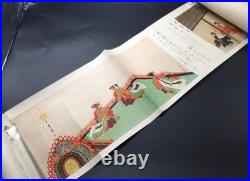
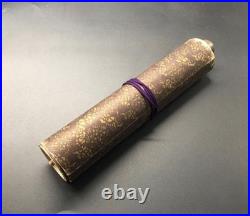
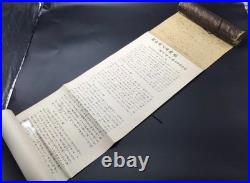
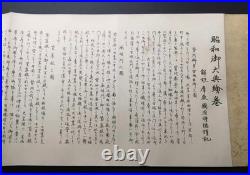
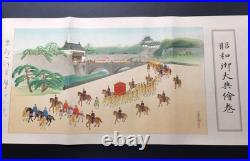
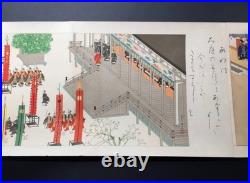
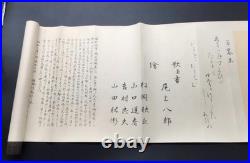
Own a Piece of History. This is an original. 1928 illustrated scroll “Showa Gotaitei Emaki”. To commemorate the enthronement ceremonies of. Emperor Hirohito (Showa Emperor). The scroll measures an impressive. 418 cm 164 in. In total length, and features beautifully printed illustrations by leading Japanese artists of the time, including. Poems are contributed by. Emperor Hirohito (Showa Emperor) reigned from. Overseeing the most dramatic and turbulent era in modern Japanese history. During the 1930s-1945 period, he stood as. The head of state of Imperial Japan. The supreme authority within the military structure. Making him a central figure in Japanese politics and wartime decision-making. This scroll records the. Created at a time when Japan was not yet at total war-capturing the nation before it entered the most consequential years of the 20th century. Because of the emperor’s role in both domestic governance and the military system, any original prewar material related to Hirohito is highly valued among collectors of. Royal and court ceremonial culture. Showa Gotaitei Emaki (Showa Enthronement Illustrated Scroll). Matsuoka Eikyu / Yamaguchi Hoshun / Yoshimura Tadao / Yamada Shuei. One wooden roller end is missing. Age-related toning, creases, light stains. Some fold lines from storage. No major tears; fully viewable. Please check all photos carefully. Authentic prewar Imperial Japan artifact. With significant historical value. Approximate 7-21days(To USA).

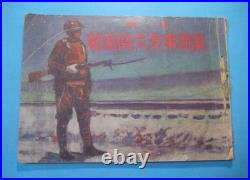
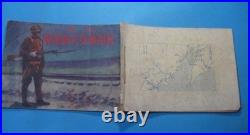
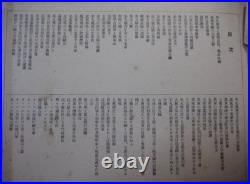
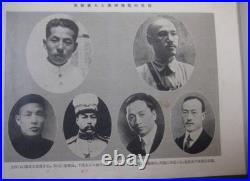
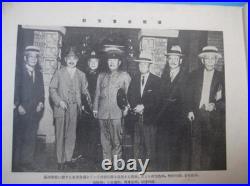
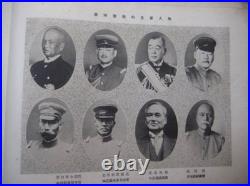
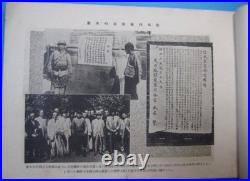
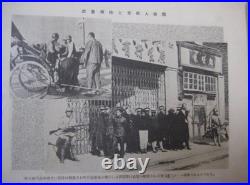
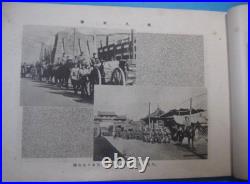
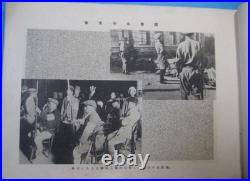
Original 1931 “Special Pictorial Record of the Manchurian Incident”. Early Showa-era photo album. Documenting the outbreak of the. The turning point that marked the beginning of Japan’s continental expansion and ultimately led to the Second Sino-Japanese War. Mukden (Liutiaohu) Railway Explosion. On September 18, 1931, near Shenyang (formerly Mukden). The Imperial Japanese Army’s Kwantung forces used this event as a pretext to launch a full-scale occupation of. Within a few months, Japan had seized major cities such as Mukden, Changchun, Harbin, and Jinzhou. This military operation shocked the international community and became a. Major prelude to World War II in Asia. ? About This Book. Provides a vivid photographic record of the campaign. Frontline scenes from Mukden, Jinzhou, Harbin, and other key locations. Portraits of leading Japanese and Chinese military and political figures. Japanese Army troop movements, artillery units, and occupation forces. Civilian life and reconstruction efforts after occupation. Detailed “Map of the Manchurian Situation” and “Japan-China War Map” on the back cover. The album serves as both a historical and visual document of early Showa Japan’s military expansion and propaganda photography. The photo portraits include. Key Imperial Japanese Army commanders. Members of the Japanese cabinet during the incident. Chinese Nationalist figures and regional leaders of Manchuria. These images collectively illustrate the. Political and military structure surrounding the 1931 Manchurian Incident. Making this album a unique record of both sides. Unlike later wartime propaganda books, this volume was produced. Immediately after the outbreak. Of the Manchurian Incident. It preserves the atmosphere and perspective of the time, offering researchers and collectors a. First-hand visual account of Japan’s early expansionism. The origins of the Sino-Japanese War. Showa-era propaganda and photojournalism. Imperial Japanese Army operations in Manchuria. Tokushu Manshu Jihen Dai Shashincho. (“Special Pictorial Record of the Manchurian Incident”). 26 × 19 cm. (cover wear, light stains, minor binding looseness). Pages remain well preserved for its age. ? Collector’s Note. A highly valuable artifact of pre-war Japanese photojournalism. Ideal for historians, collectors, and institutions interested in. Imperial Japan, military history, and early 1930s East Asia. Such complete and well-preserved copies rarely appear on the market. Manchurian Incident, Mukden, 1931, Imperial Japanese Army, Kwantung Army, Pre-WW2 Japan, Showa 6, Manchuria, China, Japanese Military Photo Album, Mukden Incident, Rare Historical Document, Propaganda Book, East Asia War History. Approximate 7-21days(To USA).

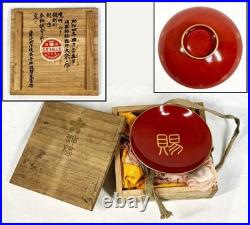
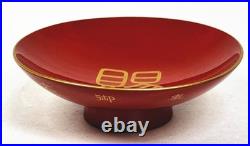
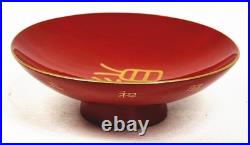
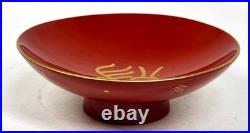
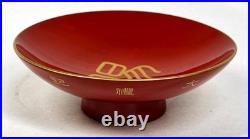
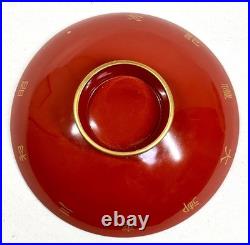
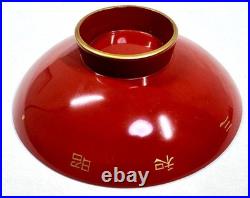
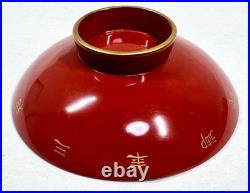
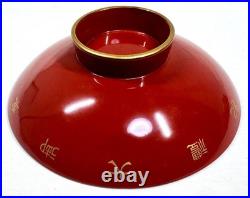
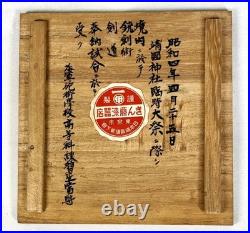
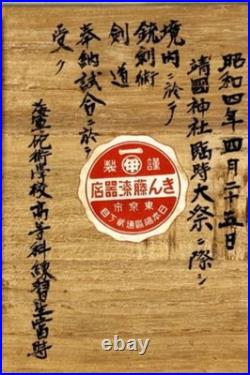
This is an original red lacquer ceremonial sake cup created to commemorate the Imperial Enthronement Ceremony (, Gotairai) of Emperor Showa (Hirohito) in 1928 (Showa 3). The inside of the cup features the bold character?? (“Tamawaru” – “Bestowed” or “Imperial Gift”), symbolizing honor and blessing. Around the outer rim, in gold lacquer, it reads. ? (“Commemorating the Imperial Enthronement Ceremony of Showa 3″). The cup is finished with a fine gilt rim. Box inscription (on the lid interior). The original wooden box has an important inscription, which connects this cup to a later historical event. Right column: Showa 4 (1929), April 25 – Yasukuni Shrine, on the occasion of the Temporary Grand Festival. Center column: Dedication of martial arts demonstrations (?) – bayonet drills and kendo matches were performed. Left column: Signed with affiliation/names (partially in cursive script, preserved as-is). The red circular seal is the mark of the original lacquerware shop. This means the cup, originally made for the 1928 Enthronement, was later dedicated or presented in 1929 at Yasukuni Shrine during a major festival, in connection with martial arts dedication ceremonies. This double provenance-Imperial and martial-greatly enhances its historical value. Who: The Japanese people, martial arts groups, and Shinto community honoring the Emperor. What: A commemorative lacquer sake cup celebrating the Showa Emperor’s enthronement and later used in a Yasukuni Shrine martial arts dedication. When: Cup produced in 1928 (Showa 3); box inscription dated 1929 (Showa 4). Where: The enthronement ceremonies were held in Kyoto; the dedication occurred at Yasukuni Shrine in Tokyo. Why: To celebrate the enthronement as a national event, and to dedicate martial arts performances to the spirits of the fallen. How: Such lacquer cups were used in ceremonial banquets and dedication rituals, then preserved in wooden boxes with inscriptions noting the occasion. Japanese lacquer (urushi) is made from the sap of the lacquer tree. It produces a hard, glossy, and durable coating admired for centuries. This cup uses red lacquer (shu-urushi) with gold-painted inscriptions and a gilt rim, typical of high-quality ceremonial vessels. Care: Avoid direct sunlight and alcohol cleaners. Simply wipe gently with a soft dry cloth. Imperial Enthronement + Yasukuni Shrine martial arts dedication – two major historical events connected in one artifact. Large bold character?? inside, symbolizing honor and Imperial blessing. Original inscribed box with provenance, making it valuable as both a ceremonial object and a historical document. Excellent for collectors of Japanese Imperial memorabilia, martial arts history, and Shinto-related artifacts. ? This is not just a sake cup, but a piece of Japanese history with strong connections to the Imperial Enthronement of Emperor Showa and the Yasukuni Shrine martial traditions of the early Showa period. Approximate 7-21days(To USA).

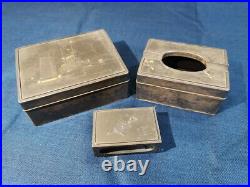
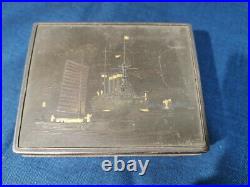
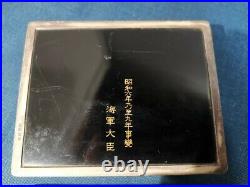
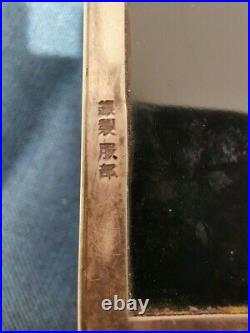
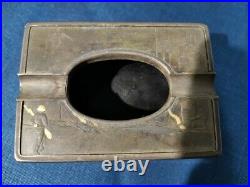
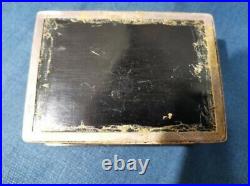
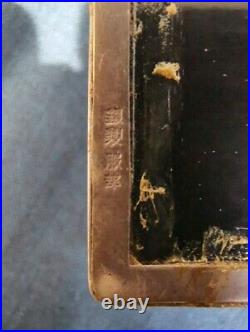
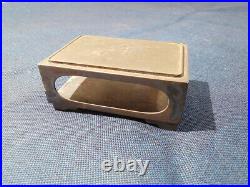
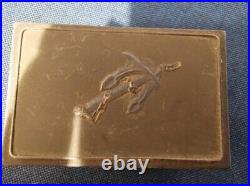
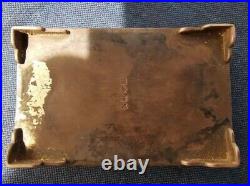
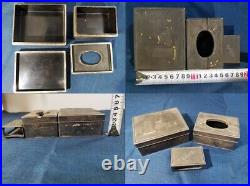
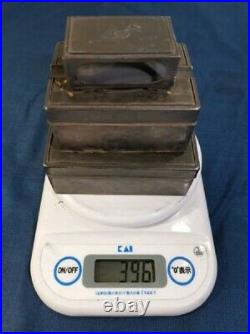
It is a product from the time of the Manchurian Incident. There is a description that includes the Navy Minister. It is a very wonderful Cigarette Set. The metal part is Sterling Silver. Silver Hattori is a contractor for the Imperial Household Agency. ¦ Size of the cigarette holder. 4 cm(1.57) in height. 8.5 cm(3.33) in length. 10.5 cm(4.12) in width. Weight 209g/ 7.36oz. ¦S ize of the matchbox. 2.5 cm(0.98) in height. 4 cm(1.57) in length. 6 cm(2.35) in width. Weight 51g/ 1.79oz. ¦ Size of the ashtray. 6.5 cm(2.55) in length. 9 cm(3.53) in width. Weight 135g/ 4.75oz. [USA / CANADA / AUSTRALIA]. This item is in the category “Collectibles\Militaria\1919-38\Original Period Items”. The seller is “hirolicur” and is located in this country: JP.
- Country/Region of Manufacture: Japan
- Original/Reproduction: Original