
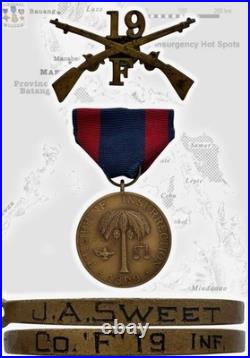
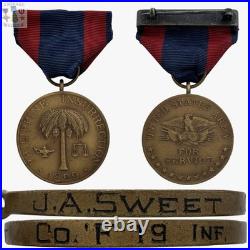
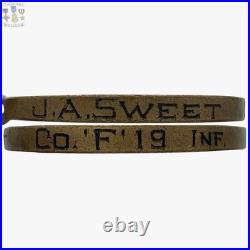
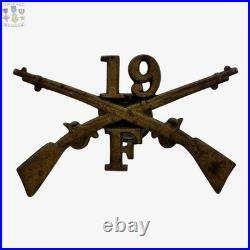

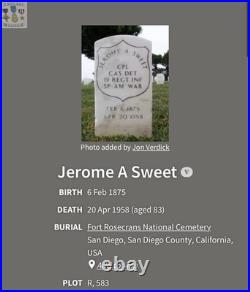
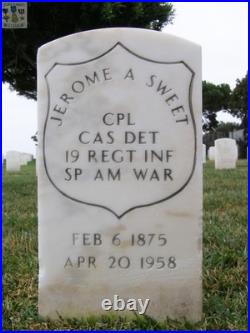
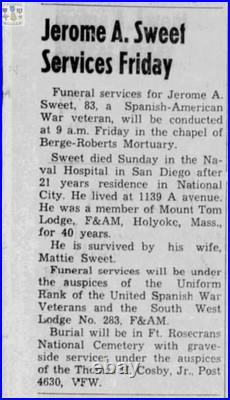
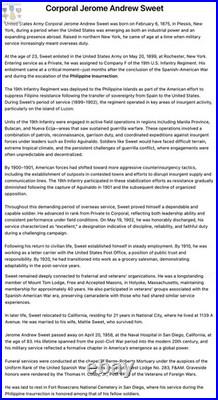
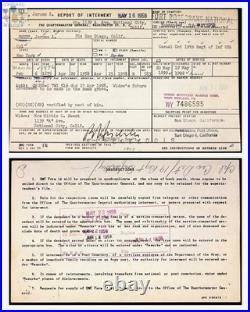
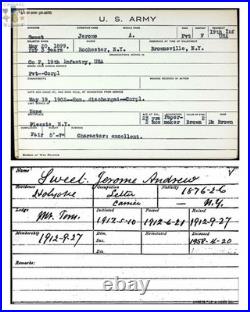
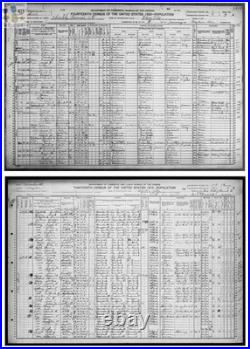
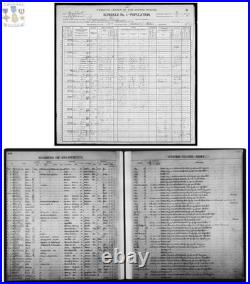
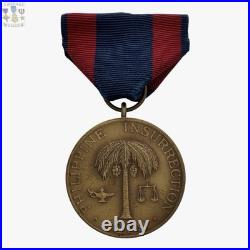
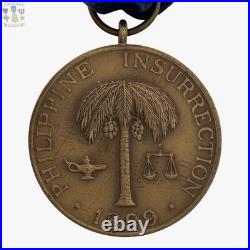
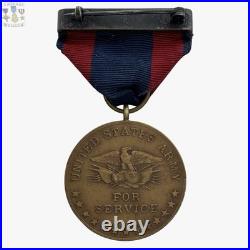
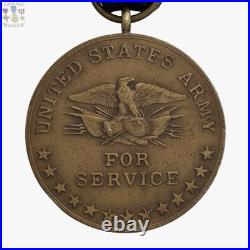
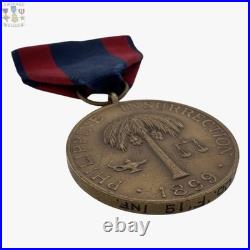
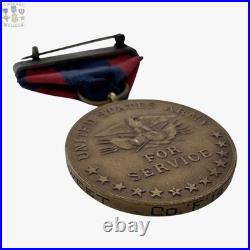
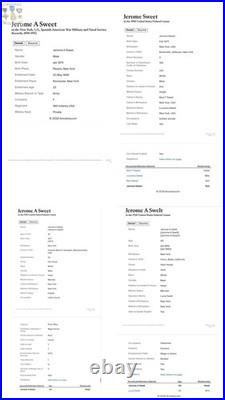
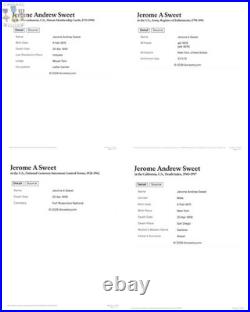

United States Army Corporal Jerome Andrew Sweet was born on February 6, 1875, in Plessis, New York, during a period when the United States was emerging as both an industrial power and an expanding presence abroad. Raised in northern New York, he came of age at a time when military service increasingly meant overseas duty. At the age of 23, Sweet enlisted in the United States Army on May 20, 1899, at Rochester, New York. Entering service as a Private, he was assigned to Company F of the 19th U. His enlistment came at a critical moment-just months after the conclusion of the Spanish-American War and during the escalation of the Philippine Insurrection. The 19th Infantry Regiment was deployed to the Philippine Islands as part of the American effort to suppress Filipino resistance following the transfer of sovereignty from Spain to the United States. Units of the 19th Infantry were engaged in active field operations in regions including Manila Province, Bulacan, and Nueva Ecija-areas that saw sustained guerrilla warfare. These operations involved a combination of patrols, reconnaissance, garrison duty, and coordinated expeditions against insurgent forces under leaders such as Emilio Aguinaldo. Soldiers like Sweet would have faced difficult terrain, extreme tropical climate, and the persistent challenges of guerrilla conflict, where engagements were often unpredictable and decentralized. The 19th Infantry participated in these stabilization efforts as resistance gradually diminished following the capture of Aguinaldo in 1901 and the subsequent decline of organized opposition. Throughout this demanding period of overseas service, Sweet proved himself a dependable and capable soldier. He advanced in rank from Private to Corporal, reflecting both leadership ability and consistent performance under field conditions. On May 19, 1902, he was honorably discharged, his service characterized as “excellent, ” a designation indicative of discipline, reliability, and faithful duty during a challenging campaign. Following his return to civilian life, Sweet established himself in steady employment. By 1910, he was working as a letter carrier with the United States Post Office, a position of public trust and responsibility. By 1920, he had transitioned into work as a grocery salesman, demonstrating adaptability in the post-service years. Sweet remained deeply connected to fraternal and veterans’ organizations. He was a longstanding member of Mount Tom Lodge, Free and Accepted Masons, in Holyoke, Massachusetts, maintaining membership for approximately 40 years. He also participated in veterans’ groups associated with the Spanish-American War era, preserving camaraderie with those who had shared similar service experiences. In later life, Sweet relocated to California, residing for 21 years in National City, where he lived at 1139 A Avenue. He was married to his wife, Mattie Sweet, who survived him. Jerome Andrew Sweet passed away on April 20, 1958, at the Naval Hospital in San Diego, California, at the age of 83. His lifetime spanned from the post-Civil War period into the modern 20th century, and his military service reflected a formative chapter in America’s emergence as a global power. Funeral services were conducted at the chapel of Berge-Roberts Mortuary under the auspices of the Uniform Rank of the United Spanish War Veterans and South West Lodge No. Graveside honors were rendered by the Thomas H. Post 4630 of the Veterans of Foreign Wars. He was laid to rest in Fort Rosecrans National Cemetery in San Diego, where his service during the Philippine Insurrection is honored among that of his fellow soldiers. I will include 21 full size color printed copies of the research presented. UNITED STATES ARMY SPANISH AMERICAN WAR PHILIPPINE INSURRECTION CAMPAIGN MEDAL W/ FULL WRAP BROOCH. STUDLEY, PRODUCED BY DAVIDSON OF PHILADELPHIA. SWEET CO’F’ 19 INF. UNITED STATES ARMY SPANISH AMERICAN WAR CO. F 19TH INFANTRY CAP BADGE. Please let me know if there’s anything else I can do for you!

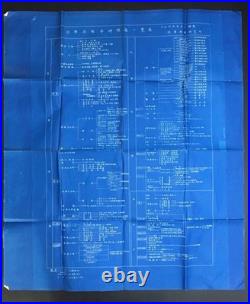
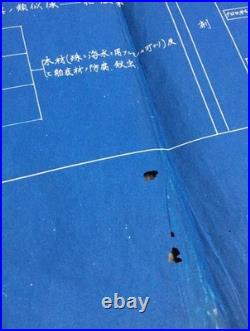
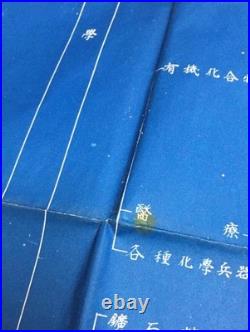
This is an original 1926 (Taisho 15) Imperial Japanese Army document. “Chemical Weapons Peacetime Application Classification Chart”. Army Scientific Research Institute (Rikugun Kagaku Kenkyusho). This large-format blueprint (cyanotype) chart systematically categorizes. Chemical weapons research, including. Organic and inorganic compounds. Industrial and peacetime applications. Production and material structure systems. Rather than being a weapon manual. This is a structured research classification chart. Showing how the Japanese Army organized its military chemical research. During the Taisho period. It represents early pre-WWII military chemistry research. Making it an important primary historical document. Printed using traditional blueprint (cyanotype) method. Large folding single sheet. Age toning and stains. Small holes visible (see photos). Overall preserved in collectible condition. This is a historical research document. International Buyers – Please Note. Thank you for your understanding.

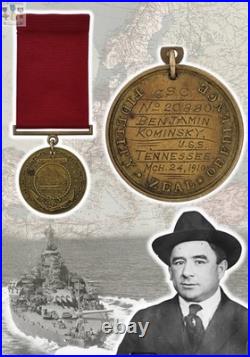
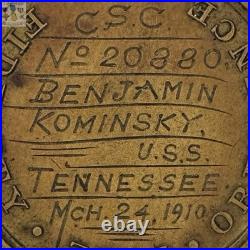
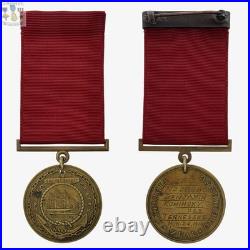
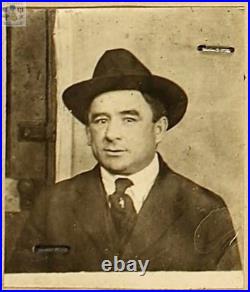
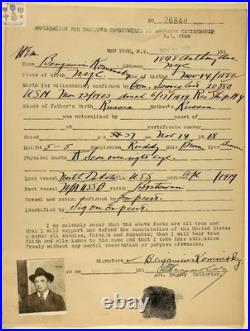
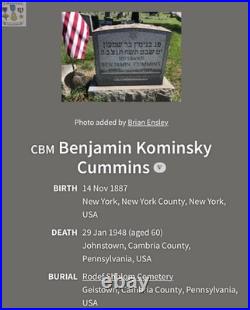
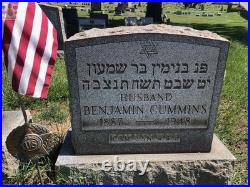
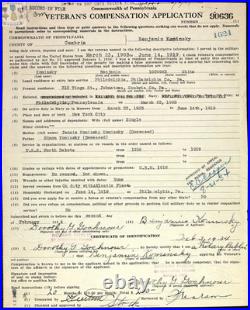
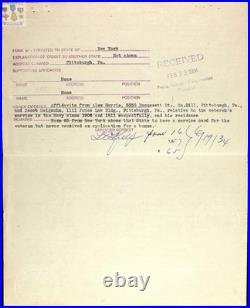
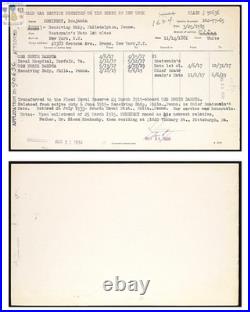
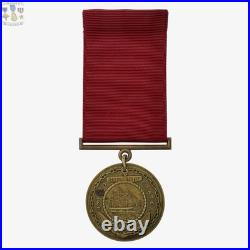
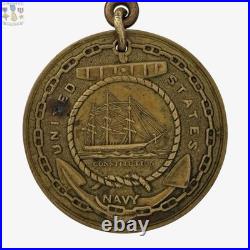
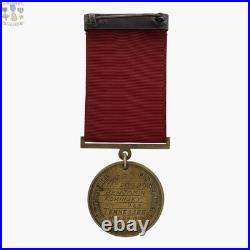
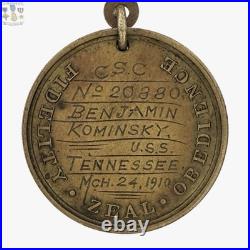
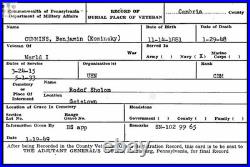
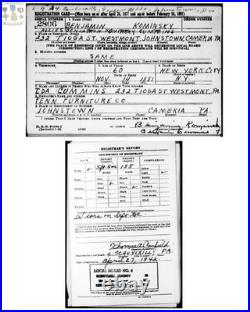
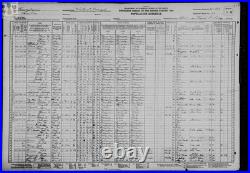
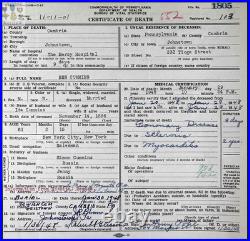
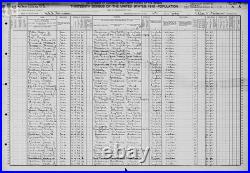
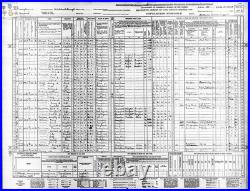
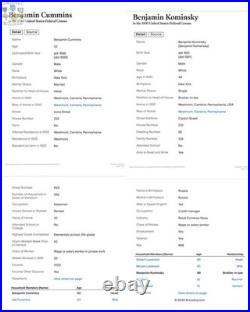
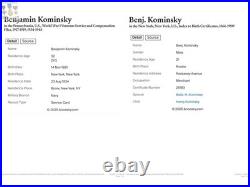
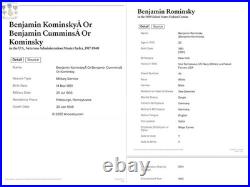
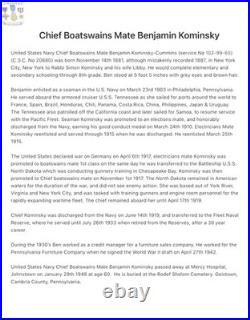
United States Navy Chief Boatswains Mate Benjamin Kominsky-Cummins (service N? 102-99-65) C. N? 20880 was born November 14th 1881, although mistakenly recorded 1887, in New York City, New York to Rabbi Simon Kominsky and his wife Libby. He would complete elementary and secondary schooling through 8th grade. Ben stood at 5 foot 5 inches with grey eyes and brown hair. Benjamin enlisted as a seaman in the U. Navy on March 23rd 1903 in Philadelphia, Pennsylvania. He served aboard the armored cruiser U. Tennessee as she sailed for ports around the world to France, Spain, Brazil, Honduras, Chili, Panama, Costa Rica, China, Philippines, Japan & Uruguay. The Tennessee also patrolled off the California coast and later sailed for Samoa, to resume service with the Pacific Fleet. Seaman Kominsky was promoted to an elections mate, and honorably discharged from the Navy, earning his good conduct medal on March 24th 1910. Electricians Mate Kominsky reenlisted and served through 1915 when he was discharged. He reenlisted March 25th 1915. The United States declared war on Germany on April 6th 1917, electricians mate Kominsky was promoted to boatswains mate 1st class on the same day he was transferred to the Battleship U. North Dakota which was conducting gunnery training in Chesapeake Bay. Kominsky was then promoted to Chief boatswains mate on November 1st 1917. The North Dakota remained in American waters for the duration of the war, and did not see enemy action. She was based out of York River, Virginia and New York City, and was tasked with training gunners and engine room personnel for the rapidly expanding wartime fleet. The chief remained aboard her until April 17th 1919. Chief Kominsky was discharged from the Navy on June 14th 1919, and transferred to the Fleet Naval Reserve, where he served until July 26th 1933 when retired from the Reserves, after a 30 year career. During the 1930’s Ben worked as a credit manager for a furniture sales company. He worked for the Pennsylvania Furniture Company when he signed the World War II draft on April 27th 1942. United States Navy Chief Boatswains Mate Benjamin Kominsky passed away at Mercy Hospital, Johnstown on January 29th 1948 at age 60. He is buried at the Rodef Sholom Cemetery. Geistown, Cambria County, Pennsylvania. I will include 20 full size color printed copies of the research presented. UNITED STATES NAVY GOOD CONDUCT MEDAL W/ REPLACED OPEN “C” CATCH FULL WRAP BROOCH. N? 20880 BENJAMIN KOMINSKY U. RE-RIBBONED DRAPE TESTED U. Please let me know if there’s anything else I can do for you!
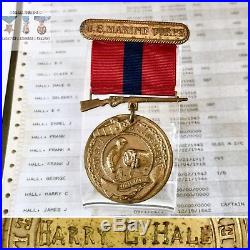
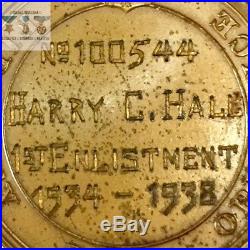
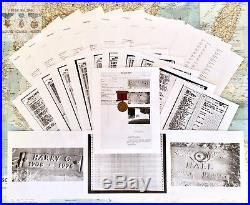
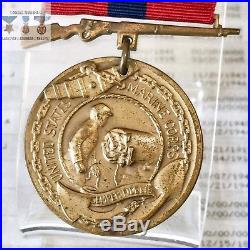
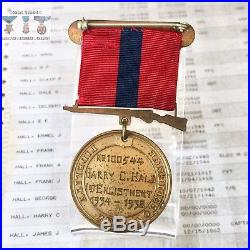
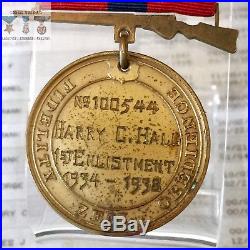
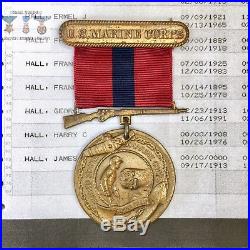
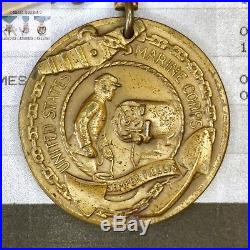
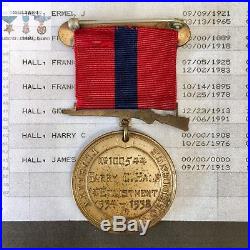
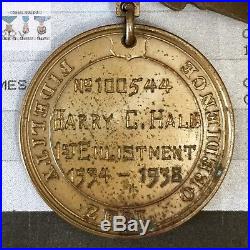
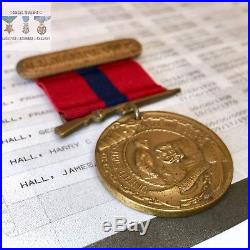
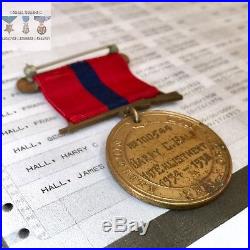
United States Marine Corps Corporal Harry C. Hall was born in Pennsylvania in 1908. Hall enlisted in the Marine Corps as a Private in Jan. Of 1934 at the Headquarters Detachment, Recruit Depot, Parris Island, S. In March 1934 Hall was attending Sea School at the Norfolk Navy Yard, Portsmouth, VA. Maryland, & the U. From New York to the Panama Canal Zone. In March of 1936 Hall was promoted to Private 1st Class. By July 1937 Hall was stationed at the League Island Pennsylvania where he reenlisted Jan. 13th 1938 & was hen promoted to Corporal in June 1938. He served with the General Service Unit , 4th Reserve District, Navy Yard, PA. Throughout 1940 & World War II. He was issued this Good Conduct Medal No. Hall passed away Oct. 26th 1976 at 68 years old. He is buried at the Mercer County, Shenango Valley Cemetery. RIBBON DRAPE TESTED UV NEGATIVE. The Marine Corps Good Conduct Medal was established on 20 July 1896. The medal was originally a ribbon and medal suspended from a clasp bearing the words U. The clasp was eliminated after WWII and the medal has remained unchanged in appearance since that time. Since its inception in 1896, the name of the recipient was engraved by hand on the reverse side of the medal until stamping the name on the medal began during World War II (numbered on the rim) and was done completely by 1951. In 1953, the Marine Corps adopted bronze and silver 3/16-inch service stars to denote additional awards of the Good Conduct Medal, replacing enlistment bars showing each honorable period of service. Since 10 December 1954, members of the Marine Corps must have three consecutive years of honorable and faithful service in order to be eligible for the medal. The Marine Corps Good Conduct Medal is affectionately nicknamed, “The Good Cookie” by Marines. Please let me know if there’s anything else I can do for you! The item “NAMED 1934-1938 MARINE CORPS GOOD CONDUCT MEDAL N100544 HARRY C. HALL +RESEARCH” is in sale since Thursday, December 07, 2017. This item is in the category “Collectibles\Militaria\1919-38\Original Period Items”. The seller is “medal_mulisha_store” and is located in Los Angeles, California. This item can be shipped worldwide.