
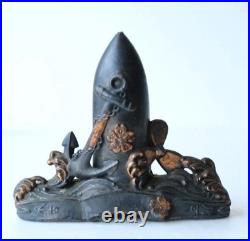
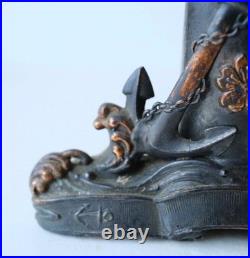
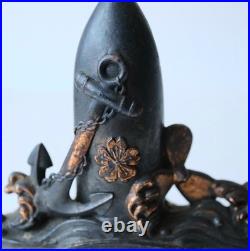
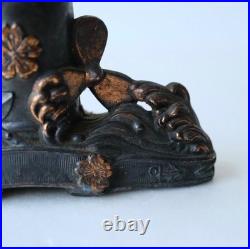
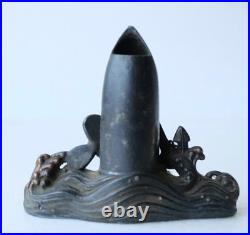
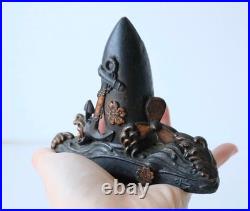
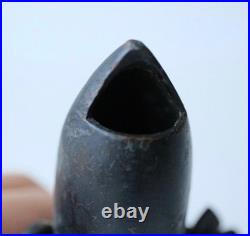
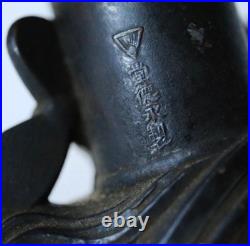

A striking prewar / WWII-era. Imperial Japanese Navy themed shell-shaped vase or decorative metal ornament. Richly designed with naval symbolism. The body is formed in the shape of an artillery shell, surrounded by detailed motifs including. Anchor, propeller, ocean waves, and sakura blossoms. These elements strongly reflect the visual culture and pride associated with the Imperial Japanese Navy. The side bears the maker’s mark. “Dodokunaga / Do Tokunaga Sei”. Indicating a named workshop or maker rather than an anonymous mass-produced item. Signed examples like this are especially desirable to collectors. Many collectors estimate naval artifacts appear only a fraction as often on the market. Decorative Navy pieces with this level of sculptural detail are particularly hard to find. This piece likely served as a commemorative object, officer’s room display, retirement gift, or patriotic home décor item of the era. It has exceptional shelf presence and tells a story immediately. A true conversation piece for militaria, naval history, or Japanese decorative arts collectors. 15.5 × 5 × 16 cm. Please review photos carefully. No major visible damage. Age wear, surface scratches, patina, and minor imperfections consistent with age. Own a Piece of History. International Buyers – Please Note. Thank you for your understanding.

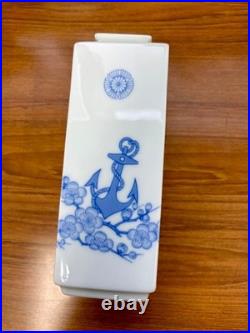
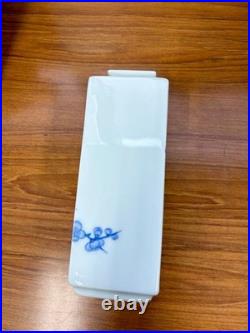
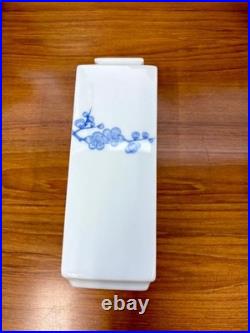
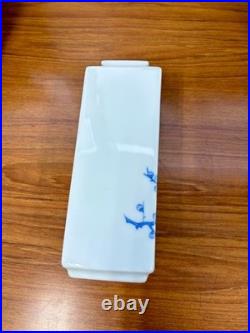
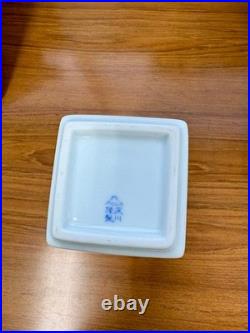
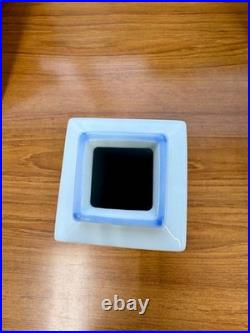
This is a prewar Japanese porcelain vase made by Fukagawa Seiji, closely associated with the Imperial Japanese Navy and the Imperial Household. The front is decorated in underglaze blue with a large Imperial Japanese Navy anchor, plum blossoms, and above them the royal crest of the Takamatsu-no-miya branch of the Imperial Family. The Takamatsu-no-miya family was one of the branches of Japan’s Imperial Household, and Prince Takamatsu himself served as an officer in the Imperial Japanese Navy. Rather than going too deeply into his personal history, the important point here is the unusual combination of an Imperial-family crest and a naval anchor on the same piece. The maker is also highly significant. Fukagawa Seiji, founded in 1894 in Arita, became one of Japan’s most prestigious porcelain manufacturers. It won a gold medal at the 1900 Paris Exposition and later became an official supplier to the Imperial Household. The underside of this vase bears the Fukagawa Seiji maker’s mark. Fukagawa also had a documented connection with the Imperial Japanese Navy. In 1916, the company became a designated Navy factory and supplied tableware for naval officers. In 1942, it was further designated as a Navy-supervised factory, producing and supplying specialized tableware and military-use ceramics. This makes Fukagawa more than simply a famous porcelain maker: during the prewar and wartime period, it had an official manufacturing relationship with the Imperial Japanese Navy. No original box or supporting provenance documents are included with this piece, but the combination of: Imperial-family crest Imperial Japanese Navy anchor Fukagawa Seiji maker’s mark makes it a particularly interesting example of Japanese military and Imperial-era porcelain. I have not found evidence that Fukagawa continued as an official designated supplier to Japan’s postwar Self-Defense Forces. Its strongest documented military connection belongs to the era of the Imperial Japanese Navy. A small porcelain vase, but one that brings together three powerful elements of prewar Japan: the Imperial Household, the Navy, and one of Japan’s most prestigious porcelain makers. Own a Piece of History. International Buyers – Please Note.

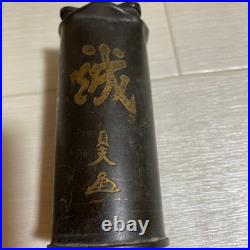
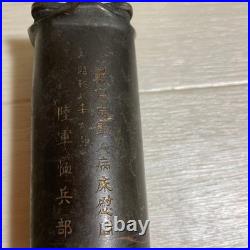
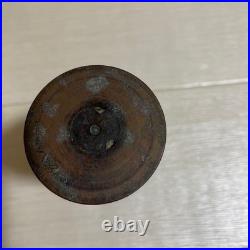
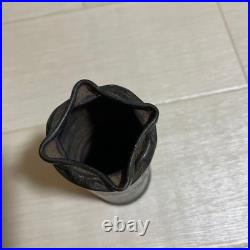
This is a 1933 Imperial Japanese Army commemorative vase connected with a hospital for wounded and sick soldiers. The inscription on the body reads: “Hospital Visit for Wounded and Sick Soldiers” “September 1933″ “Army Welfare Department” On the opposite side is the large character “Makoto” , meaning sincerity, devotion, or faithfulness. Beneath it is the inscription “Written by Sadao”. Based on the date and historical context, this inscription is believed to refer to General Sadao Araki, who was serving as Japan’s Minister of War at the time. Araki was one of the most influential Army figures of early Showa Japan and became closely associated with the Imperial Way faction and the Army’s emphasis on spiritual discipline and loyalty. The year 1933 is especially important. Japan had already entered Manchuria following the Manchurian Incident of 1931, and the state of Manchukuo had been established in 1932. In 1933, Japan announced its withdrawal from the League of Nations. This vase therefore comes from a moment when Japan was moving away from international cooperation and toward a more militarized national direction. Yet this object does not represent the battlefield itself. It represents what happened after soldiers came back wounded or sick. The Army Welfare Department was involved in activities intended to support and soldiers, including those undergoing treatment. Based on the inscription, this vase was likely produced for use during a hospital visit or event for wounded and sick servicemen. It may have been presented to a patient, placed in a military hospital ward, or used as part of the ceremony. That is what makes this piece particularly interesting. The large word “Makoto” was not simply decorative. In the Imperial Japanese military, ideas such as loyalty, sincerity, self-sacrifice, and spiritual strength were heavily emphasized. If the calligraphy is indeed connected with Sadao Araki, the message would have carried additional meaning for wounded soldiers undergoing recovery. In other words, this vase represents two sides of the same military system: compassion toward wounded soldiers-and the expectation that they maintain military spirit even while lying in a hospital bed. The surface shows age-related wear, discoloration, oxidation, scratches, and other signs of its approximately 90-year history. Please examine the photographs carefully for condition. A weapon tells us how a war was fought. This small vase tells us something different: what happened to the soldiers who survived long enough to return wounded. A rare and deeply human artifact from Japan in 1933, at a critical point on the road toward the wars that would follow. Own a Piece of History. International Buyers – Please Note.

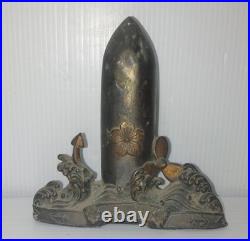
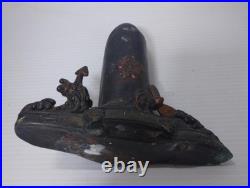
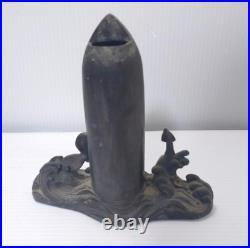
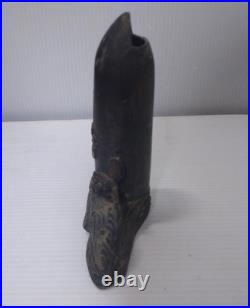
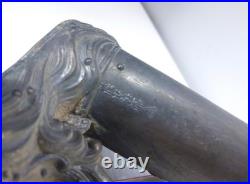
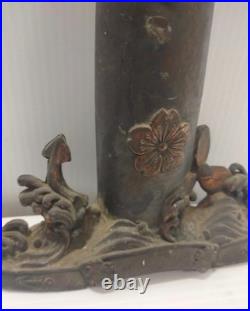
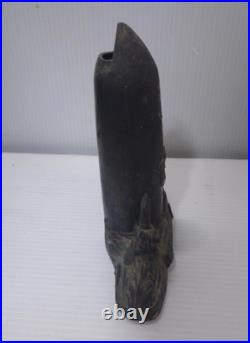
A striking prewar / WWII-era. Imperial Japanese Navy themed shell-shaped vase or decorative metal ornament. Richly designed with naval symbolism. The body is formed in the shape of an artillery shell, surrounded by detailed motifs including. Anchor, propeller, ocean waves, and sakura blossoms. These elements strongly reflect the visual culture and pride associated with the Imperial Japanese Navy. The side bears the maker’s mark. “Dodokunaga / Do Tokunaga Sei”. Indicating a named workshop or maker rather than an anonymous mass-produced item. Signed examples like this are especially desirable to collectors. Many collectors estimate naval artifacts appear only a fraction as often on the market. Decorative Navy pieces with this level of sculptural detail are particularly hard to find. This piece likely served as a commemorative object, officer’s room display, retirement gift, or patriotic home décor item of the era. It has exceptional shelf presence and tells a story immediately. A true conversation piece for militaria, naval history, or Japanese decorative arts collectors. 15.5 × 5 × 16 cm. Please review photos carefully. No major visible damage. Age wear, surface scratches, patina, and minor imperfections consistent with age. Own a Piece of History. International Buyers – Please Note. Thank you for your understanding.


WW1 1917 German 77mm Trench Art Artillery Shell Vase WWI. What a cool piece of history! I almost shuddered hitting the “used” button under the description because…. This would have been fired from a German cannon. Check out the photo with the marking’s meaning for added historical thrill. This item is in the category “Collectibles\Militaria\1919-38\Original Period Items”. The seller is “mcsalty1″ and is located in this country: US. This item can be shipped to United States.
- Country/Region of Manufacture: Germany


THIS IS A TOTALLY INERT DISPLAY ITEM WHICH HAS BEEN PERMANENTLY ALTERED AND IS NOT CONSIDERED A WEAPON UNDER THE LAWS OF ANY COUNTRY. DISPLAY ONLY THIS IS A TOTALLY INERT DISPLAY ITEM WHICH HAS BEEN PERMANENTLY ALTERED AND IS NOT CONSIDERED A WEAPON UNDER THE LAWS OF ANY COUNTRY. THE MESS THEY MADE ENDING WW1! THE TREATIES ENDING WW1 CREATED MORE WARS. THE COLLAPSE OF THE AUSTRO-HUNGARIAN EMPIRE CREATED MANY NEW CONFLICTS BETWEEN PEOPLES WHO HAD LONG BEEN SUPPRESSED FROM THEIR NATIONAL AND REGIONAL IDENTITIES. IN 1918 A UKRAINIAN NATION WAS DECLARED IN LVOV. THE LARGE POLISH POPULATION REVOLTED AND BATTLES WERE JOINED BETWEEN IRREGULAR POLISH MILITIA CALLED THE “EAGLETS” AND THE REMNANTS OF THE UKRAINIAN SICH RIFLEMEN UNIT WHICH HAD BEEN A REGULAR MILITARY UNIT OF THE EMPIRE. DIPLOMATIC EFFORTS TO END THIS FAILED AND IN MAY OF 1919 A POLISH ARMY INVADED AND OCCUPIED LVOV AND THE SURROUNDING AREA. LVOV IS ONE OF THE MOST OCCUPIED CITIES OF EUROPE. POLES, UKRAINIANS, GERMANS, ROMANIANS, SOVIETS ALL HAD TURN JUST DURING THE 20TH CENTURY. MUCH MORE VARIATION BEFORE THAT. THIS PIECE OF EXTREMELY RARE TRENCH ART WAS MADE BY A POLISH SOLDIER IN MAY OF 1919 WHEN THE POLES OCCUPIED THE CITY. IT IS MARKED LVOV MAY 1919 IN POLISH. A BEAUTIFUL GARLAND SURROUNDS THE CASE WITH SHIELD AND DATES IN TWO. THE SHELL IS A 76.2mm IMPERIAL RUSSIAN CONTRACT FIELD GUN TYPE MADE IN ENGLAND IN 1917. IN 60 YEARS OF COLLECTING I HAVE NEVER SEEN ANOTHER FROM THIS LITTLE KNOWN WAR. AS A 60+ YEAR COLLECTOR OF ORDNANCE ITEMS AND CONSULTANT I HAVE HAD THOUSANDS OF PIECES OF TRENCH ART COME MY WAY. OF THESE THOUSANDS I COLLECTED ONLY THE FINEST, RARE AND INTERESTING PIECES FOR MY PERSONAL COLLECTION. THESE RANGE FROM FANCY DECANTERS MADE FOR A GERMAN FIELD MARSHALL, TO ITEMS MADE BY A U. MEDAL OF HONOR WINNER TO A UNIQUE BOMBLET MADE FROM JAPANESE FUZES BY THE FIRST ORDNANCE SQDN. TINIAN AND PRESENTED TO COL. TIBBITS UPON HIS RETURN FROM DROPPING THE FIRST ATOMIC BOMB. MY PERSONAL COLLECTION CONTAINS ONLY 50 PIECES AND THIS IS ONE OF THEM. This item is in the category “Collectibles\Militaria\1919-38\Original Period Items”. The seller is “csaeod” and is located in this country: US. This item can be shipped to United States, Canada, Australia, Japan, China, Korea, South, Indonesia, Taiwan, South Africa, Thailand, Bahamas, Israel, Mexico, New Zealand, Philippines, Singapore, Saudi Arabia, United Arab Emirates, Qatar, Kuwait, Bahrain, Malaysia, Chile, Colombia, Costa Rica, Panama, Trinidad and Tobago, Guatemala, Honduras, Jamaica, Antigua and Barbuda, Aruba, Belize, Dominica, Grenada, Saint Kitts-Nevis, Saint Lucia, Montserrat, Turks and Caicos Islands, Barbados, Bangladesh, Bermuda, Brunei Darussalam, Bolivia, Egypt, French Guiana, Guadeloupe, Jordan, Cambodia, Cayman Islands, Sri Lanka, Macau, Martinique, Maldives, Nicaragua, Oman, Pakistan, Paraguay, Reunion, Uruguay.
- Country/Region of Manufacture: Poland