
Pre-WWII Japanese Hanging Scroll Emperors Meiji & Taisho Yasukuni Shrine
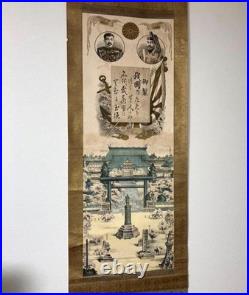
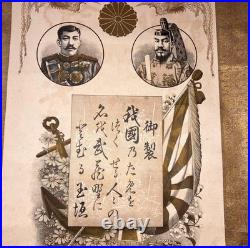
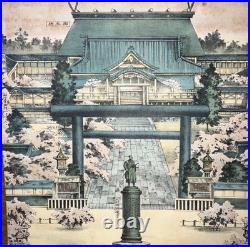
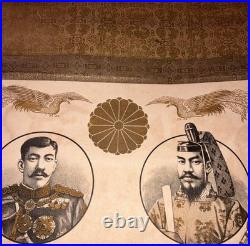
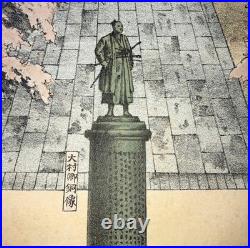
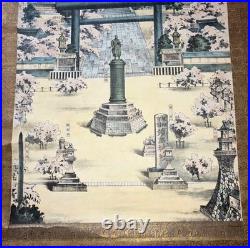
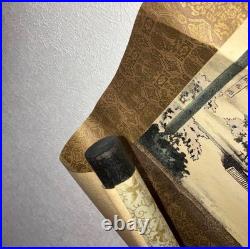
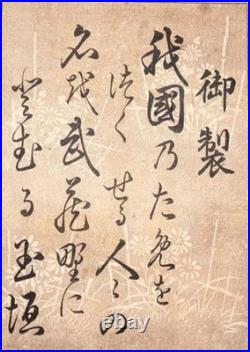
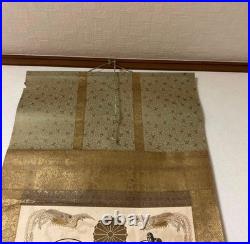

This hanging scroll is a pre-World War II Japanese historical artwork that visually explains how modern Japan understood state authority, military reform, and national remembrance. Rather than depicting combat, this piece presents the ideological framework behind war memory, making it a valuable primary visual document from early 20th-century Japan. Upper Section: Supreme Authority of the State. At the top are portraits of. During this period, the emperor was not only a monarch but the symbolic center of political and moral authority. Because Emperor Taisho is depicted, this scroll is believed to have been produced after 1910, most likely in the 1910s. Central Section: Anchor, Rising Sun, and Inscription. The center features a rising sun motif combined with an anchor, symbolizing the state and its military institutions. Above this imagery is a handwritten inscription in a style similar to imperial or commemorative verse, conveying the idea that. Those who sacrificed their lives for the nation must be remembered and honored by future generations. This section represents the ideological core of the scroll. Lower Section: Omura Masujiro Statue and Yasukuni Shrine. The lower portion depicts the bronze statue of. Omura Masujiro is widely regarded as the founder of the modern Japanese army. He introduced Western military systems and played a central role in transforming Japan’s feudal forces into a modern national army during the Meiji Restoration. Behind the statue appears. Including its torii gate and main structures. What Is Yasukuni Shrine? Yasukuni Shrine was established to enshrine those who died in service of the state. In prewar Japan, it functioned as a symbolic space where individual deaths were transformed into national memory, closely linked with state ideology and commemoration. Meaning of the Composition. The scroll follows a deliberate vertical structure. Top: The State (Emperors Meiji & Taisho). Middle: Ideology and symbolism (anchor, rising sun, inscription). Bottom: Military foundation and remembrance (Omura Masujiro & Yasukuni Shrine). This structure visually explains how authority, military reform, and remembrance were connected in pre-war Japan. Age-related toning, stains, and wear consistent with pre-WWII materials. Offered strictly as a historical and cultural artifact. No modern political intent or endorsement implied. International Buyers – Please Note. Thank you for your understanding.